Taibu
Zhouyi divination × Bazi—ask the hexagram about small things, and yourself about big ones
Introduction
Taibu is an official title found in the Zhouli—the head of the Zhou royal court’s divination office, entrusted with the methods of the Three Changes. I borrowed the name for a divination program that runs on my own computer: Zhouyi divination in its left hand, for asking about an event; Bazi in its right, for looking at a person. From the eighteen transformations of yarrow stalks to the Ten Gods and decade cycles of the Four Pillars, every hexagram and chart is produced locally. AI handles only the final step: explaining the conclusion in ordinary human language.
Where divination came from
From heating turtle shells to casting hexagrams
More than three thousand years ago, people of the Shang dynasty heated turtle shells and animal bones over fire, reading the direction of the cracks for good or ill. This is the source of Chinese divination, and oracle-bone script is the writing carved into those divination records. The Zhou inherited that tradition but changed its method, using yarrow stalks to cast and work through the sixty-four hexagrams. This became the Zhouyi: its core text took shape in the Western Zhou, while the Ten Wings that interpret it were largely formed during the Warring States period. It later stood at the head of the classical canon, so much so that people often forget it began as a book of divination. Later still, yin, yang, and the Five Phases became a shared language across the Hundred Schools, and divinatory practices branched out through it. One branch directly inherited the hexagram tradition and developed into Six Lines and Meihua Yishu, asking about the fortune of a particular matter. Another arose between the Tang and Song, using the heavenly stems and earthly branches of a birth time to reason about the shape of a life: Ziping Bazi. Today, a shop sign promising “Zhouyi forecasting · Bazi” is really hanging two systems on the same board. One asks about an event; the other interprets a life. Their origins and principles are not the same. Taibu simply implements both and keeps each in its place: Zhouyi divination asks “how will this matter unfold?”; Bazi asks “what is this person like?”
This is not an invitation to believe in fate
Taibu is not trying to persuade you to believe in fate. If we are speaking of belief, the Yijing itself does not believe in it. Open the first hexagram and it says, “As Heaven moves with strength, the noble person strives without cease.” The second says, “As Earth bears with devotion, the noble person carries the world with generous virtue.” A book of divination spends its first two hexagrams making the point bluntly: you walk the road yourself, and cultivate your own character. What divination truly offers is the moment when you put a question into words with full attention and are forced to decide what you are actually asking. The lines are ancient enough, and ambiguous enough, that when you interpret them, what you say is often the judgment you already understood about the situation. Whatever the hexagram looks like, the answer eventually returns to you. If you believe a thing is right and have chosen that road, you should walk it firmly. At most, the hexagram is a roadside sign telling you to slow down. The steering wheel remains in your hands.
Save your brain cells for the big decisions
We live in an age of excess information. Every choice arrives with too many options and too much intelligence spread out in front of us. The major decisions in life—whether to go abroad, pursue graduate study, change jobs, or move to another city—deserve everything we can bring to them: gathering information, weighing costs and benefits, and laying out the possibilities of each path. But attention and willpower are consumable resources. If choosing noodles or rice for dinner, or deciding whether to attend a small gathering tomorrow, also demands an exhausting search for the optimum, the ammunition will be gone before the decisions that matter arrive.
Interestingly, ancient people did the opposite: they divined precisely for major affairs—“the great affairs of the state are sacrifice and war.” Turtle shells and yarrow stalks served battles and rites. I use the tool in reverse, with good reason. For important matters, people today have much better tools than turtle shells: information, data, and due diligence. For small matters, however, the ancient mechanism still has no real substitute. It can give you an acceptable answer in a minute, and let you settle on it without guilt. Taibu therefore has only one rule of use: cast the small matter, choose, and do not look back; deliberate on the great matter, and let divination merely listen.
Cast the small matter, choose, and do not look back; deliberate on the great matter, and let divination merely listen.
The Taibu method
Taibu has two engines. Zhouyi divination makes one cast for one matter and asks, “how will this matter unfold?” Bazi builds one chart for one person and asks, “what is this person like?”
Zhouyi divination
First, write down what you are asking. The first step in divination is not shaking out a hexagram; it is making the question specific. Then choose one of four casting methods:
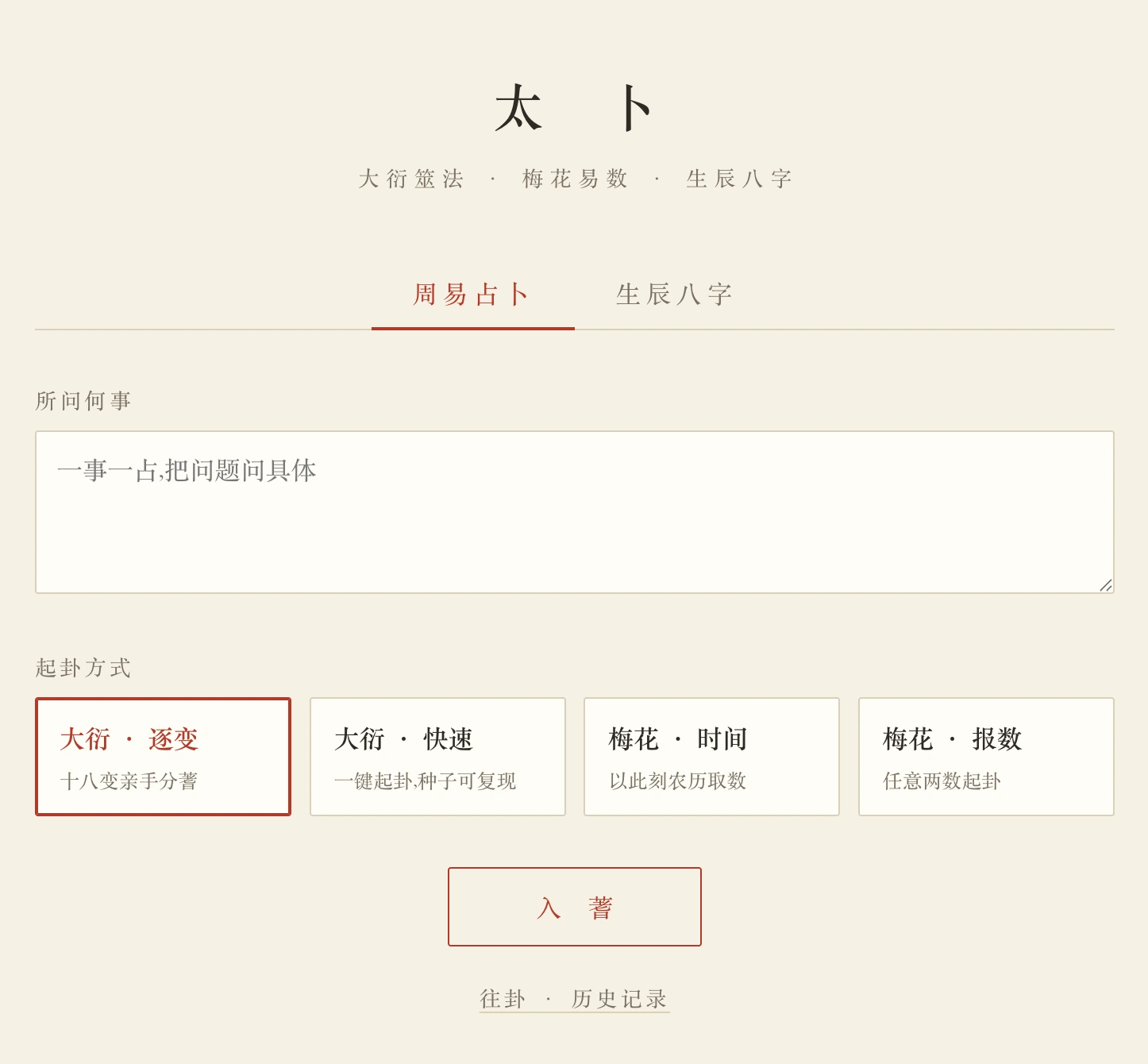
Dayan · step by step
A complete simulation of the eighteen transformations in the Dayan yarrow-stalk method recorded in the Xici. Forty-nine stalks appear on screen, and you personally click “divide in two” for every transformation. Three transformations form one line; eighteen form a hexagram. A ritual that took the ancients half an hour becomes two or three minutes of focused attention.
Dayan · quick
The same algorithm casts a complete hexagram in one action. Its random seed is recorded, and the same seed will always reproduce the same hexagram.
Meihua · time
The lunar year, month, day, and hour at the instant you press the button become the numbers for the cast. The present moment is the hexagram.
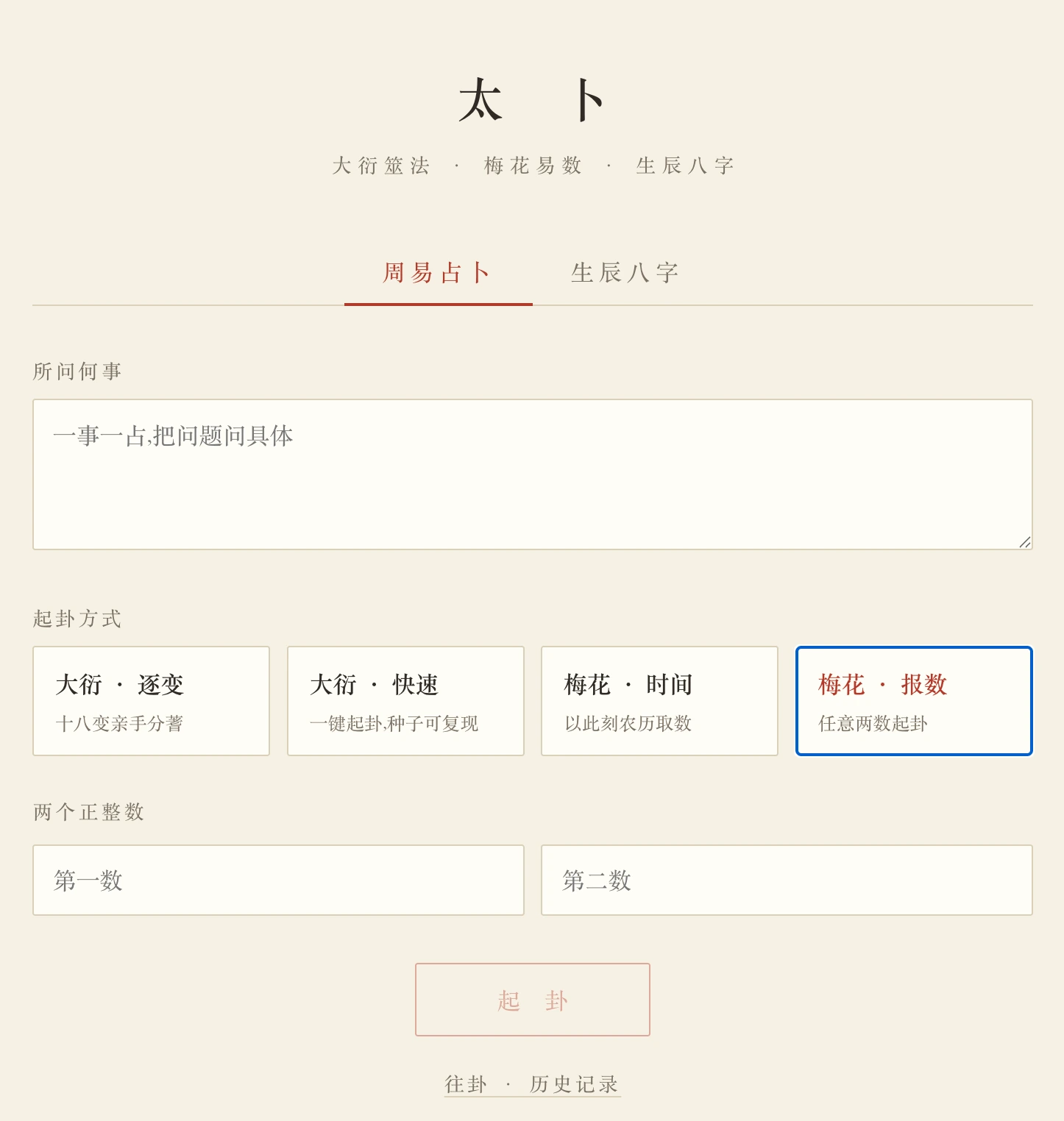
Meihua · numbers
Say any two numbers and cast. It is the fastest method when you are away from home.
The result page includes the private subject of the reading, so I will describe it rather than show it. The original and resulting hexagrams appear side by side. Changing lines use the traditional marks: ○ for old yang and × for old yin. Following the rules for reading changing lines that Zhu Xi organized in the Yixue Qimeng, the program selects the passages that should be read for this cast from the sixty-four hexagrams and 384 lines. It presents the original hexagram and line statements and their Xiaoxiang texts, together with a plain-language judgment for every line. The most important step comes last. Press “Generate interpretation,” and AI combines the hexagram, the classical text, the judgments, and the matter you asked about into one fluent explanation. It answers your question directly first, then unpacks what the hexagram is saying, streaming the response character by character like a knowledgeable friend speaking across the table.
Bazi
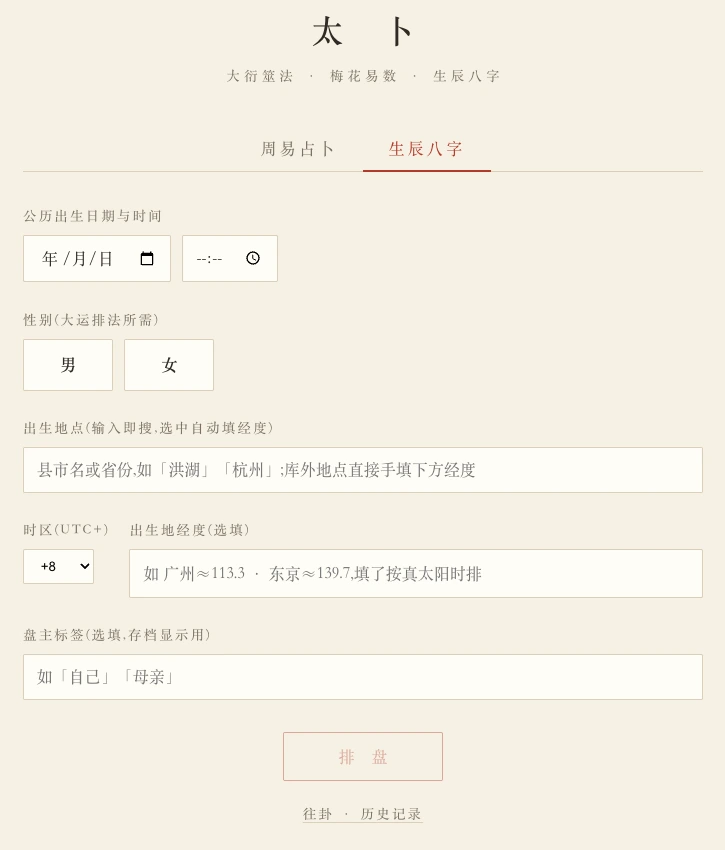
Enter the Gregorian birth date and time, and gender, which is needed to determine the forward or reverse order of the decade cycles. Search as you type for the birthplace; selecting it fills in the longitude automatically. With longitude available, the program corrects for true solar time before building the chart.
In the resulting chart—which I likewise do not show—the heavenly stems, earthly branches, and hidden stems of all Four Pillars are each labeled with their Ten Gods, while the Day Master is highlighted in cinnabar. The Five Phases distribution is visible at a glance. Strength is assessed through three tests—season, roots, and support—and the program gives its reasoning for each one. A timeline of ten decade cycles begins at the calculated starting age, marks the cycle you are currently in, and includes the current annual cycle. This is the design I am proudest of on the Bazi side: every card on the decade-cycle timeline can be opened. If you want to know about the decade from age thirty to thirty-nine, select that card and AI generates an interpretation only for those years. Select the current decade cycle and it discusses the current year as well. A life does not need to be explained all at once. Ask separately about the part you care about.
The chart’s diagnostic layer has grown considerably deeper. Beyond combinations and clashes, the Six Harms, the Three Punishments, and self-punishment are now part of the chart—clashes are shown in cinnabar, punishments in pale ochre, and harms in gray, so three levels of color reveal their relative weight at a glance. I kept only the six Shensha that seasoned practitioners actually consult: Tianyi Nobleman, Peach Blossom, Traveling Horse, Yang Blade, Canopy, and General Star. Every judgment is written from both sides; the Yang Blade can be a weapon, but also a surgeon’s scalpel. Then come pattern selection from the Month Command—the chart page tells you directly which pattern your chart belongs to—along with Xunkong and Nayin. None of this is left for AI to decide. The local engine computes it deterministically first, matches it with the judgments I wrote into the database one by one, and AI only translates them into plain language. It is explicitly forbidden to invent conclusions: if something is not in the supplied material, it cannot say a single word about it.
The new “Ask About a Matter” view is the entry point I use most. You do not type out a question; you choose a domain—career and finances, love and relationships, health, education and growth, or personality traits. Once selected, the program filters the judgments triggered in your chart according to that domain’s rules and lays them out one by one, each with its basis. A small field lets you add specific context, but it only helps AI make the wording relevant; it cannot change any conclusion. The most important rule is etched into the prompt: do not answer “is it suitable?” or “can it work?” Ask “am I suited to running a business?” and it first rejects the framing, then lays out the strengths and weaknesses in your chart—the decision always belongs to the person; the chart only supplies the underlying colors.
Bazi Compatibility
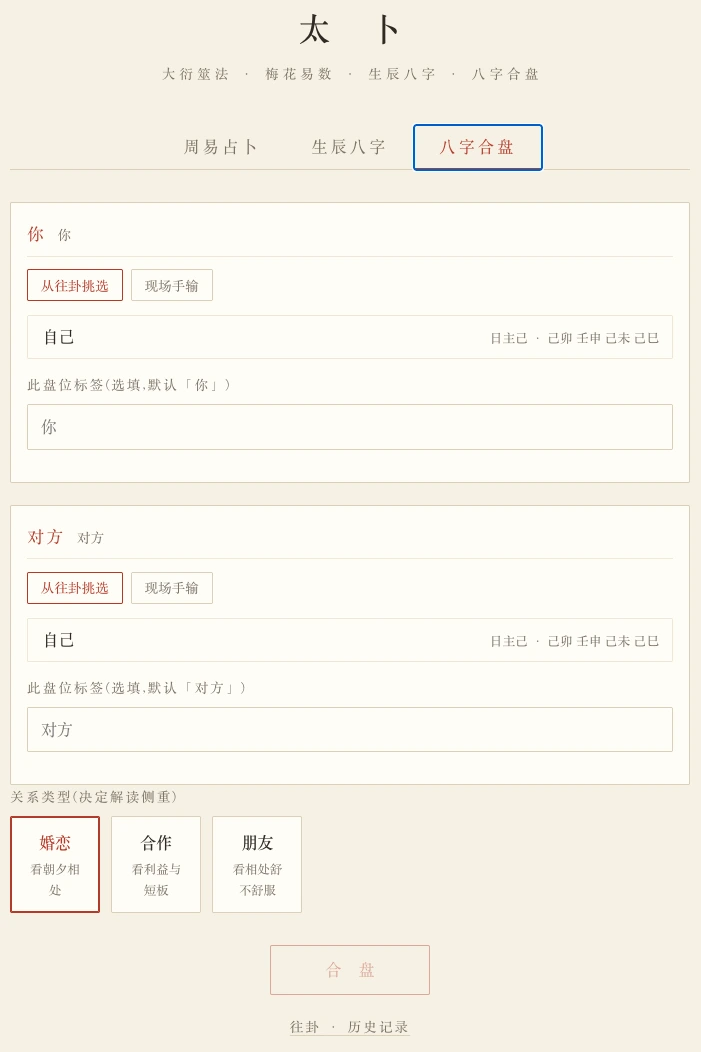
Reading two charts together is a different craft. Choose two charts already calculated, or enter one on the spot, then choose the relationship type—romance looks at living together day by day, partnership at interests and blind spots, friendship at whether being together feels comfortable. The interpretation follows the emphasis you select.
The result page is built entirely from programmatic calculations. The interaction between the Day Pillars first sets the tone for the two relationship palaces: does the other person generate me or do I generate them; do the two palaces clash or rest together? Mutual Ten Gods explain the role each person occupies in the other’s eyes. Then come cross-chart Five Combinations of Heavenly Stems and the combinations, clashes, punishments, and harms among Earthly Branches—if the same pair of branches both clashes and punishes, both are shown plainly, without smoothing it over. The most vivid part is when a formation comes together: branches that cannot form anything in either chart alone can, when the two are joined, complete a Three Harmony formation. It is the most concrete expression of affinity in the compatibility reading. Each person’s Shensha are also listed; if both share the same star—both have Traveling Horse, or both have Canopy—there is a dedicated shared-star judgment. Five-Phase complementarity is explained in both directions: whether you fit what the other favors and whether the other fits what you favor, one-way or mutual, clearly marked in red and gray.
The first iron rule of compatibility is the one I wrote most forcefully: never deliver a verdict. It does not say “suited or unsuited,” and it does not say “will it work or not.” Clashes and punishments become “places that need care”; combinations and formations become “where strength gathers”; the conclusion returns the decision to the people involved. The charts only describe whether your inborn temperaments get along. Compatibility is made in the living of it.
Face Atlas
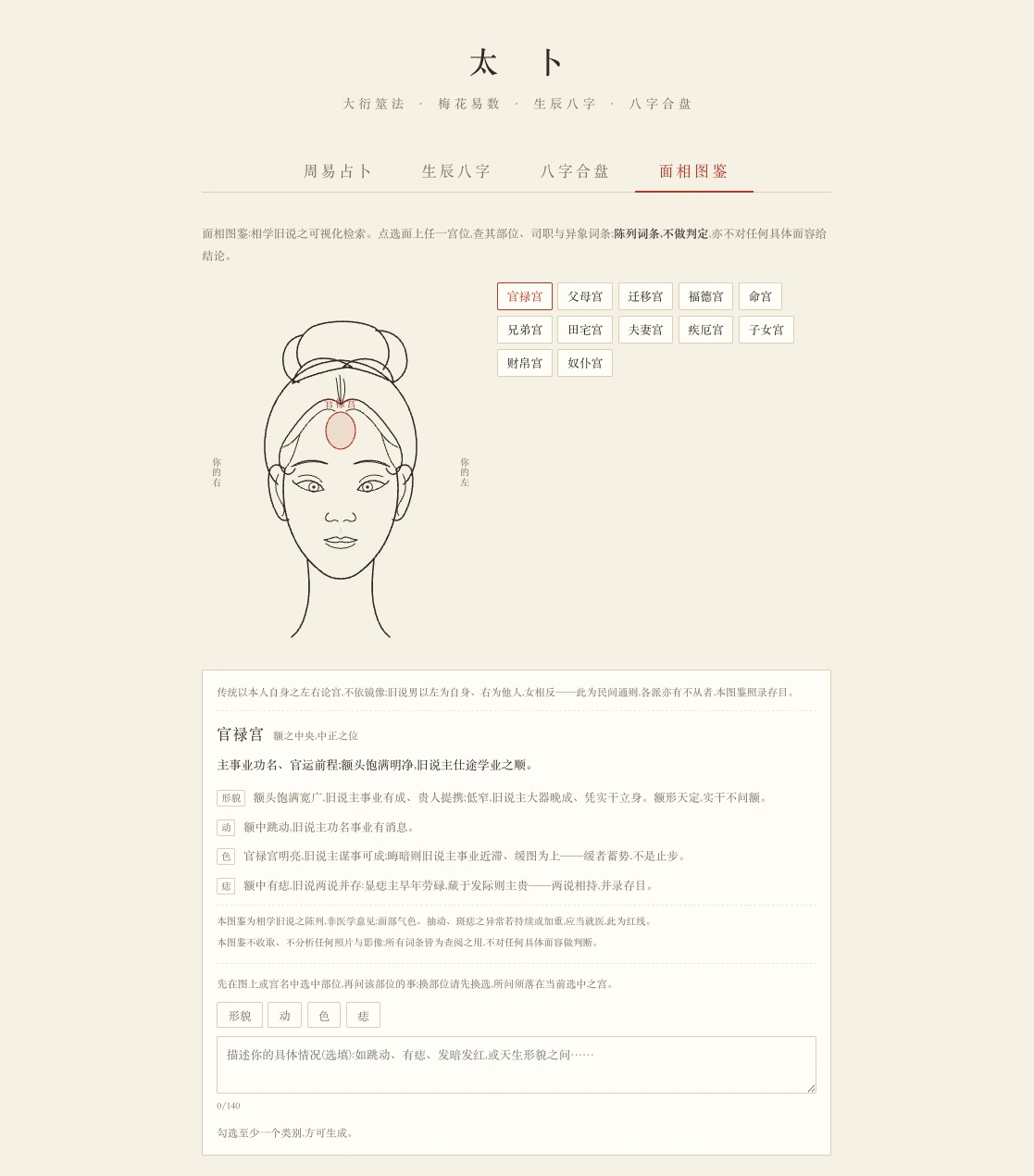
Face reading is the newly opened fourth tab, but it is different in kind from the first three: those three divine; this one is an atlas. I state its role at the top of the page: a visual reference for traditional face-reading lore, presenting entries without making judgments. At its center is a line drawing of a woman that took three illustrators to finalize. Each of the twelve palaces is a clickable region: select a place and look up that place—what the feature is called, what it traditionally governs, and how older sources interpret a twitching eyelid, a darkened yintang, or a mole hidden in the eyebrow. Everything is an entry, and every sentence is explicitly marked “traditional lore” or “traditional.” That is not a stylistic flourish. A real assertion in the program checks every sentence for those words, and the build fails if even one is missing. The two sides of the illustration are labeled “your right” and “your left,” because face reading assigns palaces by the person’s own left and right rather than by a mirror image; facing a screen, that is the easiest thing to reverse.
Below the entries is Ask the Face. Select a palace, check a category—twitching, complexion, moles, lines, or an inborn feature—then add a sentence about your specific situation, and AI explains that palace’s entries in plain language. The rules are stricter than on the Bazi side: without a selected palace, you cannot ask; after selecting one palace, you cannot ask about another. For complexion or twitching, it must first mention common physiological causes such as fatigue or eye strain, then present the traditional account and leave its weight for you to judge. For inborn features such as a large nose or thick eyebrows, it only reports how the old sources list them: it does not extrapolate good or bad fortune, and it does not infer the whole face from one feature. One final red line is welded in place: this module neither accepts nor analyzes photographs. It is a conversational atlas, not a machine that reads faces.
Past readings
Every hexagram and Bazi chart is archived automatically: when it was made, what was asked, which hexagram appeared, and any interpretation already generated. Everything can be reviewed at any time or exported together as a backup. Data is stored only locally on your device; prying into another’s privacy is improper, and what is improper is not mine to see.
How it works
Every hexagram and chart is produced by local, deterministic code, with no cloud black box mixed in. The Dayan method simulates the actual sequence of dividing in two, setting one aside, counting by fours, and gathering the remainder. The difference between the observed line-value distribution and the traditional 1/16, 5/16, 7/16, and 3/16 proportions is less than two parts per thousand. The Bazi engine runs a full set of mathematical self-checks, including the continuity of the sixty-day Jiazi cycle, the Start of Spring boundary, and cross-checks using the Five Tigers and Five Rats formulas. The complete texts of all sixty-four hexagrams and line-by-line judgments are stored locally. AI is pinned to a single task: “turn established conclusions into plain language.” It may not invent judgments or reverse good and ill. The only network call is that one plain-language generation.